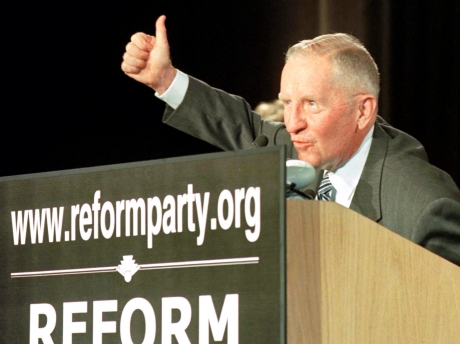
Ross Perot may have lost the election, but the damage has been done: once he got it in people’s heads that government could be run like a business, the madness won’t go away! In fact, we even pulled the trigger (did we ever) by electing a Harvard MBA and binnethman in 2000 and insanely again in 2004. This “business mind” increased the national debt from $144B to $962B (or, 1.4% to 6.8% of the GDP), and its embrace of “free market” policies led to unbridled neglect and greed on Wall Street and banking, resulting in one of the greatest economic crises in the nation’s history.
Why? Because government isn’t business. It’s WAY more complex.
In business, you have up to 3 primary stakeholders: shareholders, customers and employees. Some would even argue that only the first segment really matters.
In government you have citizens, special interest groups, the disadvantaged, the states, the national defense, the environment and diplomacy to worry about (I KNOW this is a partial list). This is in addition to budgetary and fiscal responsibilities, which cross all sorts of jurisdictional lines and interests.
Some people think putting in a “businessperson” to head up the government will make it more efficient. While that may be true, it will ultimately blow up, as it did in 2008. That is because government’s primary responsibility is not efficiency. It’s to serve its electorate. That’s why we (used to?) call government employees “civil servants.” Of course, it should do this as efficiently as possible…but efficiency is not the end.
I witnessed this degree of “messiness” and complexity in government as a Coro Community Fellow ten years ago. A group of us from non-profits, media and yes, business, participated in a 3-month intensive program, exposing us to the thorny issues of policy and governing. It was there that I learned that elected officials must collaborate, negotiate and yes, compromise, to get the “business” of governing done. No maverick, rules-be-damned-I’m-doing-it-myself slash-and-burn measures work in this context. It’s what we get when we vote in a representative democracy. The elected officials need to work together to represent all of our interests, and not just a special few.
That means extra time to hash through issues with multiple stakeholders and dimensions and perspectives. Lots of time and patience. It is inefficient. It is messy. And it is representative democracy. I wouldn’t have it any other way.
Dude, your proposed “reform” just made the mess messier.